

Software development used to follow a clear sequence. Develop. Test. Deploy. Each step happened separately. Teams worked in silos. Developers wrote code. Operations deployed it. Testing happened at the end. It worked slowly. As digital products became central to business growth, that separation began creating delays. Releases took longer. Bugs appeared late. Fixes required coordination across teams. That’s where DevOps services began changing the rhythm of software delivery.
Development and operations should not compete
When development teams push updates quickly but operations teams prioritize stability, tension builds. Developers want speed. Operations want control. Without alignment, both suffer. A professional DevOps services company in Pakistan creates collaboration between development and operations. Instead of passing work across departments, teams work within shared pipelines.
Coordination improves. Conflict reduces.
Automation reduces human error
Manual deployment processes introduce risk. Configuration mistakes. Missed dependencies. Environment mismatches.
Modern DevOps practices rely on automated pipelines. If you explore how DevOps automation helps teams release faster, you’ll see how structured workflows move code from development to production seamlessly. Automation ensures consistency. Consistency improves reliability.
Repetition becomes controlled.
Continuous integration improves quality
Waiting until the end to test software creates surprises. Efficient DevOps services implement continuous integration. Every code change triggers automated testing. Errors are identified early. Fixes happen before deployment.
For deeper insight, see how DevOps services are essential for cloud-first businesses where early testing and integration are critical.
Early detection reduces downtime. Quality becomes proactive instead of reactive.
Faster releases increase competitiveness
Markets move quickly. Features must launch faster. Updates must respond to user feedback promptly. DevOps services shorten release cycles. Small updates deploy frequently. Large updates break into manageable stages.
Speed improves without sacrificing stability. Competitive advantage increases when delivery accelerates.
Infrastructure as code strengthens consistency
Traditional server management involves manual configuration. Different environments may behave differently. Infrastructure as code standardizes setup. Servers, networks, and environments are defined through code. Replication becomes predictable. Scaling becomes easier.
Learn more about scalable systems through DevOps services for scalable, secure, and high-performance environments. Consistency reduces deployment risk.

Monitoring supports stability
Deployment does not end with release. Applications require continuous monitoring. Performance metrics.
Error tracking. Resource usage. Modern DevOps strategies include real-time monitoring tools. Issues are detected before users report them.
Visibility strengthens confidence. Maintenance becomes continuous.
Scalability aligns with growth
As user traffic increases, infrastructure must adjust automatically. Manual scaling slows response time. DevOps services integrate auto-scaling cloud infrastructure. Resources expand or reduce based on demand.
Performance remains stable. Growth does not overwhelm systems.
Security integrates into the pipeline
Modern DevOps includes Develops principles. Security checks occur during development not after deployment. Vulnerability scans run automatically. Dependencies are validated.
Secure coding practices are enforced early.
Security becomes embedded in workflow. Prevention reduces future risk.
When DevOps becomes necessary
DevOps services become essential when:
- Release cycles slow down
- Deployment errors increase
- Teams operate in silos
- Infrastructure scaling feels inconsistent
Small static websites may not require advanced pipelines. Growing digital platforms benefit significantly. Delivery speed influences market relevance.
Local expertise improves collaboration
For businesses operating in Pakistan, working with a local DevOps services company ensures better communication and faster execution. Time-zone alignment improves coordination. Local expertise speeds up troubleshooting. Context strengthens implementation.
Where Chromeis fits
Chromeis provides efficient DevOps services designed to streamline software delivery and improve infrastructure stability.
Instead of isolated automation tools, Chromeis integrates:
- DevOps automation pipelines
- Continuous integration workflows
- Cloud infrastructure scaling
- Security validation within deployment cycles
Software delivery should feel controlled not chaotic. Chromeis ensures development speed aligns with operational reliability.
Final thought
Software growth depends on delivery speed. But speed without structure creates instability. Efficient DevOps services align development and operations into one coordinated system.
When automation supports deployment and monitoring ensures performance, releases feel smooth. And when delivery becomes predictable, innovation accelerates confidently.
FAQs
1. What are DevOps services and why are they important?
DevOps services combine development and IT operations to improve collaboration, automate workflows, and speed up software delivery while maintaining stability and security.
2. How does DevOps automation improve software delivery?
DevOps automation reduces manual errors, speeds up deployment, and ensures consistent environments through automated pipelines and continuous integration processes.
3. When should a business adopt DevOps services?
Businesses should adopt DevOps when they experience slow releases, frequent deployment errors, scaling challenges, or lack of coordination between teams.
4. Are DevOps services useful for small businesses?
Yes, especially for growing startups and digital platforms. While small static sites may not need full DevOps, scalable businesses benefit greatly from automation and faster delivery cycles.
Similar Post

How DevOps Bridges the Gap Between Development and IT Operations
Building software has become faster than ever. Businesses release
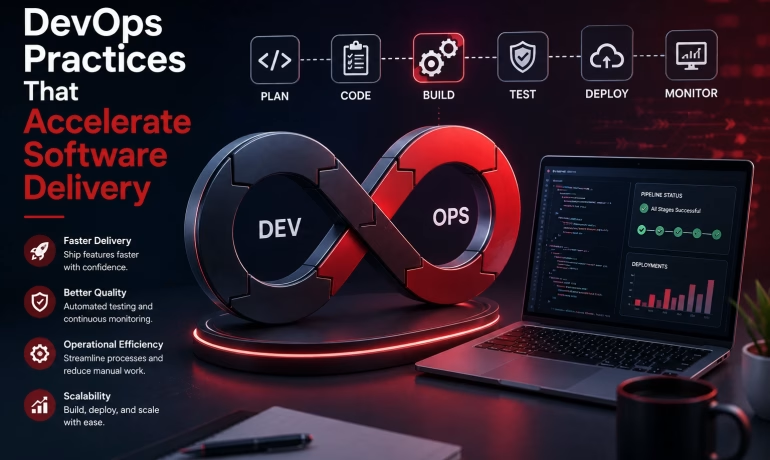
DevOps Practices That Accelerate Software Delivery
Software development has changed. Years ago, businesses planned one