
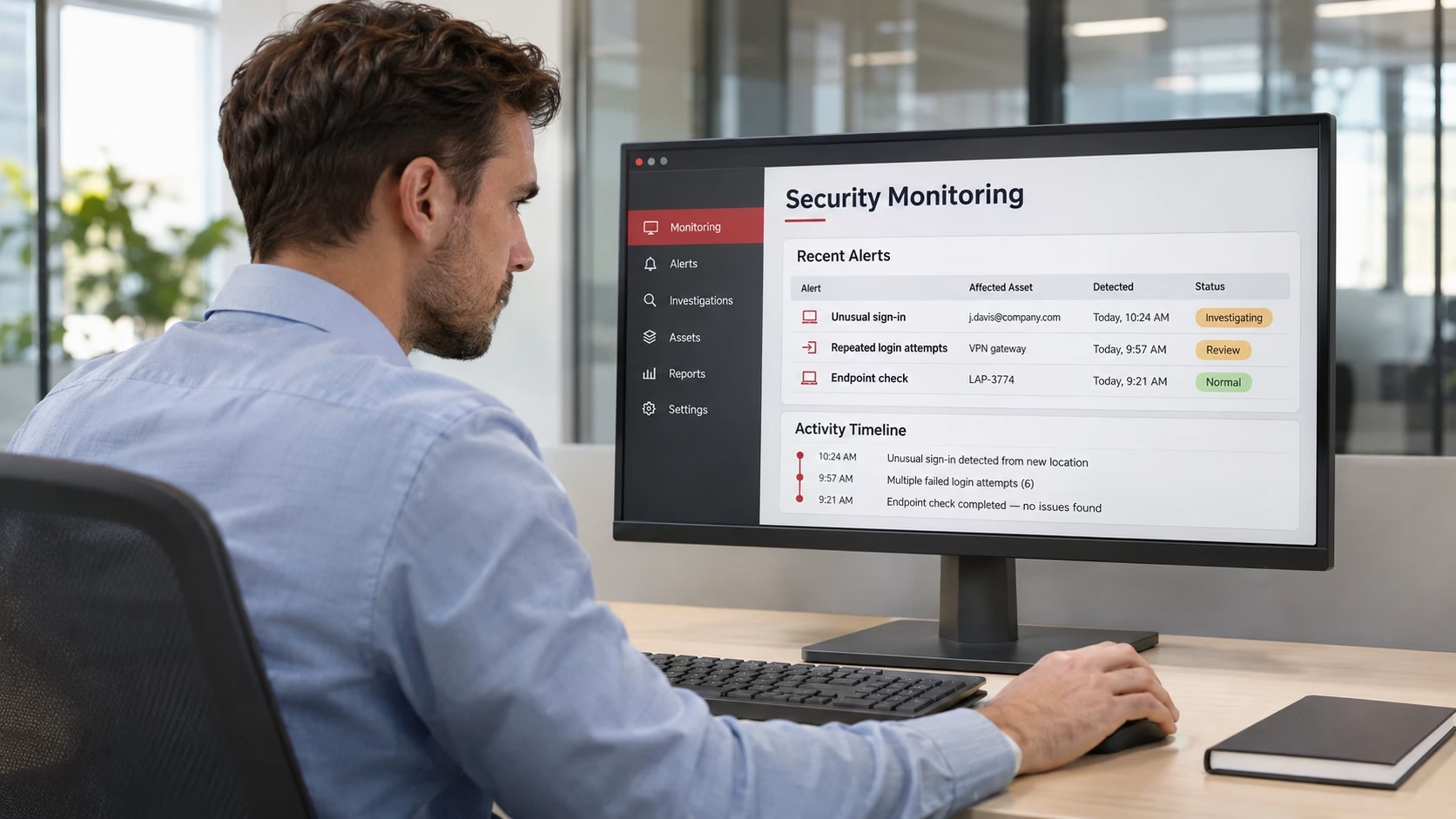
Businesses depend on digital infrastructure to manage customer information, process transactions, communicate with employees, and deliver online services. However, every connected system can introduce security risks that require ongoing attention.
A compromised account, unusual network connection, suspicious login attempt, or unexpected change to a critical system may indicate a developing security incident. If these warning signs go unnoticed, an attacker may gain additional access, disrupt operations, or expose sensitive business information.
Continuous cyber security monitoring helps organizations identify suspicious activity by collecting and analyzing security-related information from systems, networks, applications, and endpoints.
Rather than relying exclusively on periodic security checks, businesses can use ongoing monitoring to investigate potential threats, prioritize alerts, and respond to incidents more effectively.
For organizations that depend on reliable IT infrastructure, continuous security monitoring can be an important component of a broader cybersecurity strategy.
What Is Continuous Cyber Security Monitoring?
Continuous cyber security monitoring is the ongoing observation and analysis of IT environments to identify potential security threats, policy violations, and abnormal system behaviour.
Depending on the monitoring solution, this process may involve collecting logs, reviewing authentication events, monitoring network traffic, detecting endpoint threats, and analyzing alerts generated by security tools.
The objective is to identify potentially harmful activity as early as practical and provide the information needed for investigation and response.
Common monitoring activities include:
- Reviewing suspicious login attempts
- Monitoring network connections and traffic patterns
- Detecting unusual account behaviour
- Identifying malware-related alerts
- Monitoring endpoint security events
- Reviewing changes to critical systems
- Investigating unexpected privilege escalation
- Tracking security incidents and their resolution
Continuous monitoring does not mean every alert is a confirmed attack. Security teams must investigate the available evidence to distinguish genuine threats from legitimate activity.
Why Businesses Need Continuous Security Monitoring
Cybersecurity threats can develop outside normal working hours, and suspicious activity may initially appear insignificant.
For example, several unsuccessful login attempts may indicate password guessing. An unusual login followed by changes to account permissions may warrant a more detailed investigation.
Without suitable monitoring, these events may remain unnoticed until a user reports a problem or the incident begins affecting business operations.
Understanding the cyber security risks every business should know helps organizations recognize common threats and determine which activities require closer monitoring.
Continuous security monitoring helps organizations improve visibility into their IT environments and identify warning signs that require attention.
Key benefits can include:
- Earlier identification of suspicious activity
- Improved visibility into system and network events
- Faster investigation of potential incidents
- Better prioritization of security alerts
- More informed incident response
- Improved security reporting and accountability
The effectiveness of monitoring depends on the quality of the data collected, the rules and detection methods used, the availability of trained personnel, and the organization’s ability to respond to alerts.
1. Detect Suspicious Login Attempts and Account Compromise
User accounts are common targets for attackers because compromised credentials can provide access to business applications, email, and internal systems.
Monitoring authentication activity can help identify unusual patterns, including repeated failed logins, unexpected login locations, unfamiliar devices, and sign-ins occurring at unusual times.
For example, a business account may suddenly attempt to access an internal system from an unfamiliar environment and then request elevated permissions.
Such activity does not automatically prove that the account has been compromised, but it may justify additional verification.
Businesses can strengthen account monitoring by combining security logs with multi-factor authentication, identity protection tools, access restrictions, and clear account management policies.
These preventive measures demonstrate how cyber security protects businesses from online threats by reducing exposure to unauthorized access and credential-based attacks.
When suspicious activity is confirmed, the response may include revoking sessions, resetting credentials, reviewing access permissions, and investigating how the account was compromised.
2. Monitor Network Traffic for Unusual Behaviour
Network monitoring helps organizations identify communication patterns that may indicate a security problem.
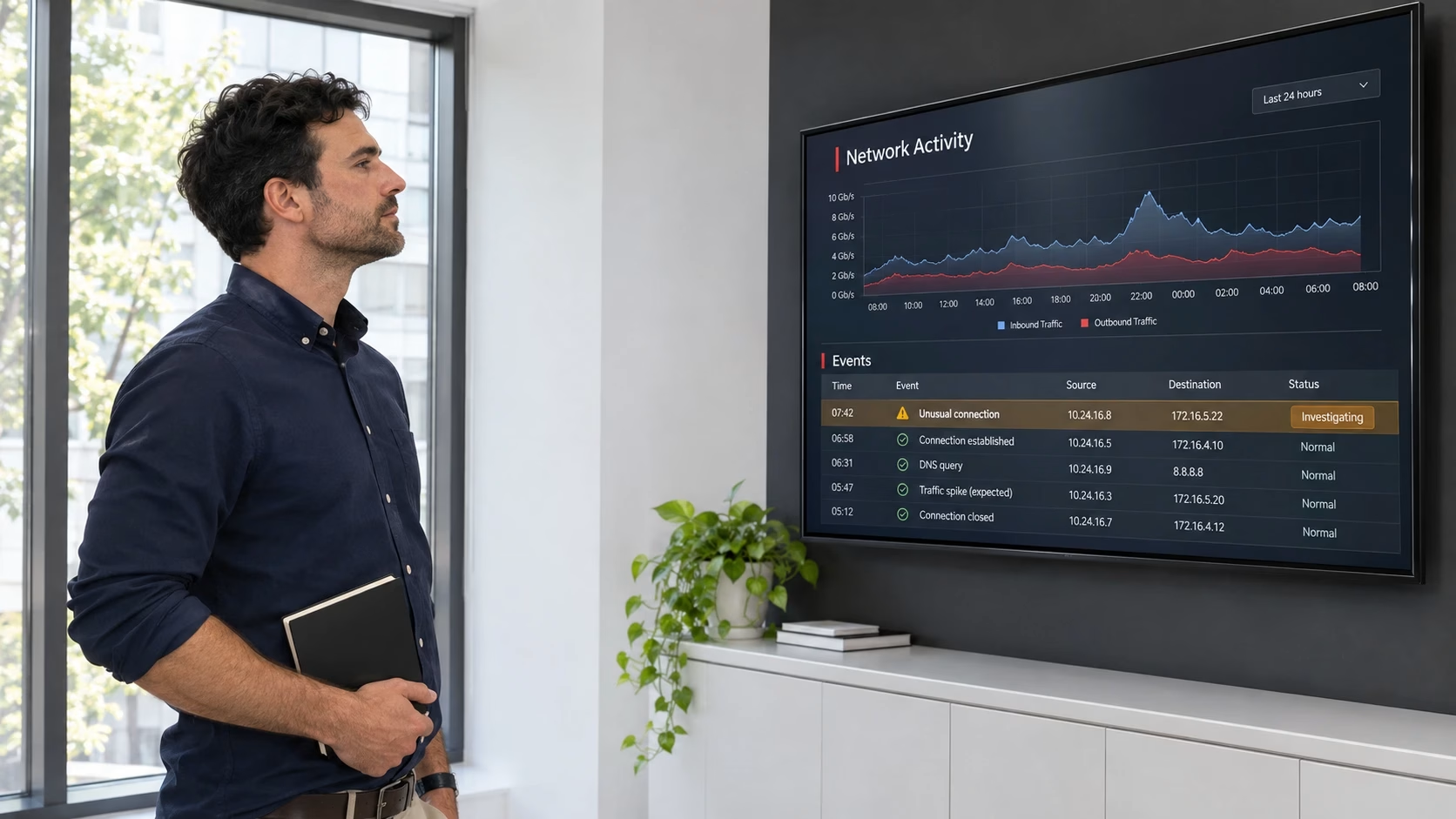
Examples include unexpected connections to unfamiliar destinations, unusual outbound data transfers, repeated connections to blocked services, and traffic patterns that differ significantly from normal operations.
For instance, a workstation that begins transmitting unusually large volumes of data to an unfamiliar external destination may require investigation.
However, network anomalies can also result from legitimate software updates, backups, new applications, or changes in business activity.
Effective monitoring therefore requires context, suitable detection rules, and a process for validating alerts before taking disruptive action.
Organizations should also review firewall configurations and restrict unnecessary network access to reduce exposure.
3. Identify Endpoint Threats and Malware Activity
Endpoints such as laptops, desktops, and servers can become entry points for cyberattacks.
Malicious software may attempt to execute unauthorized processes, modify system settings, establish persistence, or communicate with external command-and-control infrastructure.
Endpoint security tools can help detect suspicious processes, malicious files, and other indicators of compromise.
Continuous monitoring brings these events into a broader security picture, allowing investigators to correlate endpoint alerts with account activity, network connections, and other system events.
A layered cyber security approach for business infrastructure combines endpoint protection, network security, access controls, and monitoring to address threats across multiple areas of an organization’s IT environment.
Businesses should ensure that endpoint protection is installed where required, updated regularly, and configured to report relevant security events.
When a serious alert occurs, the response may involve isolating the affected device, preserving relevant evidence, investigating the incident, and restoring the system through an approved recovery process.
4. Use Centralized Security Logs for Better Visibility
Security information is often distributed across servers, firewalls, endpoints, cloud platforms, and business applications.
Investigating an incident can become difficult when administrators must access each system separately to understand what happened.
Centralized logging collects relevant events in a common location, making it easier to search, correlate, and review security information.
Depending on the environment, businesses may collect logs related to:
- Authentication and account activity
- Firewall and network events
- Server operating system activity
- Endpoint security alerts
- Application errors and access events
- Administrative configuration changes
- Cloud service activity
Centralized logs can help investigators reconstruct events and identify relationships between otherwise separate alerts.
However, log collection must be designed carefully. Businesses should establish suitable retention periods, protect logs against unauthorized changes, and ensure that sensitive information is handled appropriately.
5. Apply SIEM Tools to Correlate Security Events
Security Information and Event Management (SIEM) platforms collect and analyze security events from multiple sources.
They can apply detection rules and correlation logic to identify patterns that may be more significant than individual events.
For example, several failed login attempts followed by a successful login and an unexpected privilege change may indicate a possible account compromise.
A SIEM platform can help bring these events together so that security teams can investigate them as a connected sequence.
Depending on the solution, SIEM capabilities may include searchable security logs, dashboards, alert prioritization, reporting, and integrations with incident response tools.
However, deploying a SIEM platform does not automatically guarantee effective threat detection. Organizations need appropriate log sources, well-designed detection rules, ongoing tuning, and personnel who can investigate alerts.
For smaller businesses, a focused monitoring solution may be more practical than implementing a complex platform without sufficient operational support.
6. Identify Vulnerabilities Before They Are Exploited
Monitoring suspicious activity is only one part of reducing cyber risk. Organizations should also identify and address weaknesses that could allow attackers to gain access.
Vulnerability management involves identifying known security weaknesses, assessing their significance, and prioritizing remediation.
Relevant activities may include reviewing vulnerability scan results, tracking outdated software, monitoring security advisories, and checking whether important security updates have been applied.
For example, an internet-facing server running vulnerable software may require urgent attention, especially if the vulnerability is actively exploited.
Continuous monitoring can complement vulnerability management by helping teams observe suspicious activity around exposed systems.
Businesses looking to build a stronger cyber security strategy should combine vulnerability assessments, preventive security controls, continuous monitoring, and documented incident response procedures.
However, monitoring is not a replacement for patch management, secure configuration, vulnerability assessment, or penetration testing. These activities serve different but complementary purposes.
7. Respond to Security Alerts Before They Escalate
Detecting suspicious activity is useful only when the organization can investigate and respond appropriately.
A documented incident response process helps employees and security teams understand what to do when a potentially serious alert occurs.
A practical response workflow may include:
- Validate the alert: Review the available evidence and determine whether the activity is suspicious.
- Assess the risk: Identify the affected systems, accounts, data, and business functions.
- Contain the threat: Apply appropriate controls to prevent further unauthorized activity.
- Investigate the cause: Determine how the incident occurred and whether other systems are affected.
- Recover safely: Restore normal operations after addressing the underlying issue.
- Review the incident: Document findings and improve controls to reduce the likelihood of recurrence.
Not every alert requires the same response. The urgency should reflect the potential impact, confidence in the detection, and the criticality of the affected systems.
Businesses should define escalation procedures and responsibilities before an incident occurs.
8. Protect Cloud Infrastructure and Remote Access
Cloud services and remote access technologies expand the number of environments that businesses need to secure.
Organizations may rely on cloud servers, virtual machines, remote desktops, business email platforms, and externally accessible applications.
Monitoring should cover relevant security events across these environments rather than focusing exclusively on the office network.
Depending on the architecture, useful signals may include cloud account activity, configuration changes, remote login events, firewall alerts, and unusual access to sensitive resources.
As organizations adopt more connected technologies, understanding why cyber security is important for modern enterprises becomes increasingly relevant to protecting distributed infrastructure and business-critical systems.
Businesses should combine monitoring with multi-factor authentication, least-privilege access, secure configuration, and regular updates.
The exact monitoring approach depends on the cloud platform, available logs, service configuration, and the organization’s security requirements.
9. How to Choose Cyber Security Monitoring Services
Businesses without a dedicated security team may consider working with a provider that offers appropriate monitoring and incident support.
Before selecting cybersecurity monitoring services, evaluate the following factors.
Monitoring coverage: Determine whether the service covers endpoints, servers, networks, cloud environments, and relevant applications.
Detection capabilities: Ask how suspicious activity is identified, prioritized, and investigated.
Alert handling: Confirm whether the provider only sends alerts or also supports investigation and response.
Response times: Understand the agreed response arrangements for different incident severities.
Reporting: Check whether the service provides useful incident summaries, trends, and recommendations.
Integration: Verify compatibility with your existing security tools and infrastructure.
Data handling: Review log retention, access permissions, privacy requirements, and the location of stored information.
Cost and scope: Confirm the services included, exclusions, operating hours, and any additional incident response charges.
A suitable provider should offer a monitoring approach that matches the organization’s risk profile and operational capacity.
For organizations evaluating their security requirements, understanding why cyber security is essential for every business can also help clarify the importance of investing in appropriate protection and monitoring measures.
Why Choose Chromeis for Cyber Security Services?
Chromeis provides technology services for businesses seeking to strengthen their digital operations. Organizations evaluating cyber security monitoring should first identify their critical systems, existing security controls, monitoring gaps, and incident response requirements.
Businesses exploring cyber security services in Lahore can visit Chromeis to learn more about available security solutions and discuss their infrastructure protection requirements.
Before engaging a provider, confirm the specific monitoring services available, supported environments, alert handling arrangements, response coverage, reporting capabilities, and pricing.
Want better visibility into your IT security? Start by identifying which systems contain your most important data and determine how suspicious activity would be detected, investigated, and contained.
Final Thoughts
Continuous cyber security monitoring helps organizations observe activity across their IT environments and identify events that may indicate an emerging security incident.
By combining centralized logging, endpoint monitoring, network visibility, SIEM capabilities, and documented response procedures, businesses can improve their ability to investigate suspicious activity and respond to potential threats.
However, monitoring alone cannot prevent every attack. Effective protection also requires secure configurations, timely updates, strong authentication, access controls, and a well-defined incident response process.
For businesses seeking stronger security visibility, a monitoring strategy aligned with their infrastructure and risk profile can provide a practical foundation for more effective threat detection.
Frequently Asked Questions
What is continuous cyber security monitoring?
It is the ongoing collection and analysis of security information from systems, networks, applications, and endpoints to identify suspicious activity and potential threats.
Why is continuous security monitoring important for businesses?
It can improve visibility into security events, support earlier threat detection, and help organizations investigate potential incidents before they cause greater disruption.
What is the difference between SIEM and continuous security monitoring?
Continuous security monitoring is the broader practice of observing and analyzing security activity. SIEM is a technology category that collects and correlates security events to support detection, investigation, and reporting.
Can continuous monitoring prevent all cyberattacks?
No. Monitoring helps identify suspicious activity but cannot guarantee prevention. Businesses also need preventive controls, secure configurations, updates, and incident response procedures.
Do small businesses need security monitoring?
Small businesses can benefit from monitoring, especially when they depend on internet-facing services, business email, customer data, or remote access. The solution should be proportionate to their risks and resources.
What should I look for in a cybersecurity monitoring provider?
Evaluate monitoring coverage, detection capabilities, alert handling, incident response arrangements, reporting, integration, data protection, and total cost.
How does continuous monitoring support incident response?
It provides security events and contextual information that can help investigators identify affected systems, understand suspicious activity, prioritize containment, and document incidents.
Similar Post
Why Layered Cyber Security Matters for Protecting Modern Business Infrastructure
Businesses today operate in a highly connected digital environment.

How Businesses Can Build a Stronger Cyber Security Strategy
Businesses today depend heavily on digital systems. Customer information