

Every business reaches a point where simple systems stop feeling simple. In the beginning, everything is manageable.
Sales are tracked in spreadsheets. Customer information is stored in separate files. Departments work independently.
Nothing feels complicated. Until the business grows. More customers arrive. More employees join. More software is introduced.
Suddenly, information is scattered everywhere. Sales can’t see what support is doing. Finance waits for reports. Management spends more time collecting information than making decisions.
That’s usually when businesses begin looking at enterprise solutions. Not because their existing systems stopped working. Because they stopped working together.
Growth creates operational complexity
Growth is exciting. But it changes how businesses operate.
What worked for a team of ten people may not work for a team of one hundred.
Departments become larger. Processes become longer. Approvals increase.
Information moves through multiple people before decisions are made.
Without connected systems, even routine tasks begin taking longer than they should.
Different departments often work with different information
One of the biggest challenges growing businesses face is inconsistency. The sales team has one set of customer information.
Finance has another. Support has something different. Everyone believes their information is correct.
The problem isn’t inaccurate data. The problem is disconnected systems.
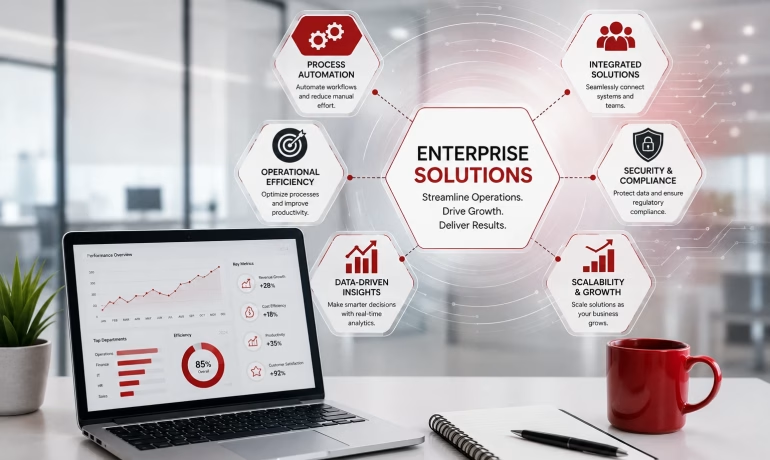
Enterprise solutions help bring those systems together so everyone works from the same information.
If you’re exploring Enterprise Solutions and Why Do Businesses Need, you’ll see how integrated platforms eliminate information silos and improve collaboration across departments.
Manual processes quietly reduce productivity
Many businesses don’t notice how much time is spent on repetitive work. Copying information.
Updating multiple systems. Sending approval emails. Preparing reports. Each task seems small. Together, they consume hours every week.
Enterprise solutions automate many of these activities, allowing employees to focus on work that creates value instead of repeating the same administrative tasks.
Better decisions depend on better visibility
Business leaders make decisions every day. Hiring. Budgets. Inventory. Customer service. Expansion.
Good decisions depend on reliable information.
When reports are delayed or incomplete, decision-making becomes slower and less confident.
An integrated enterprise solution provides better visibility across the organization, making information easier to access when it’s needed most.
Customer experience improves behind the scenes
Customers rarely see internal business systems. They notice the results. Faster responses. Accurate invoices.
On-time deliveries. Better communication. Enterprise solutions improve these experiences by helping departments work together more efficiently.
The technology stays in the background. The customer notices the service.

Businesses become easier to scale
Every growing organization reaches a point where adding more people doesn’t automatically solve operational problems.
Sometimes it creates new ones. More communication. More approvals. More coordination.
Enterprise systems help businesses scale processes alongside people.
Growth becomes more structured instead of more complicated.
Organizations running resource-intensive ERP platforms or enterprise databases can also benefit from Bare Metal Infrastructure for High Performance Enterprise, providing dedicated resources and consistent performance for mission-critical applications.
Data becomes more valuable when it’s connected
Every department generates information. Sales. Marketing. Finance. Operations. Customer support.
Separately, each dataset tells part of the story.
Together, they provide a much clearer picture of how the business is performing.
Connected systems make it easier to identify trends, measure performance, and respond to changing business conditions.
Every business has different operational needs
There isn’t a single enterprise solution that fits every organization. A manufacturing company works differently from a healthcare provider.
A retailer operates differently from a financial institution.
That’s why successful enterprise systems are designed around business processes rather than forcing businesses to change how they operate.
The technology should support the organization. Not the other way around.
Businesses usually invest after inefficiencies become obvious
Very few companies implement enterprise systems on day one. The decision usually comes later.
After duplicate work increases. After reporting becomes difficult.
After communication gaps begin affecting customers.
The earlier these operational challenges are addressed, the easier future growth becomes.
Where Chromeis Fits
Chromeis helps businesses implement enterprise IT solutions that connect departments, simplify workflows, and improve operational visibility.
By understanding how each organization works, Chromeis designs solutions that integrate business processes instead of adding unnecessary complexity.
The objective is to help businesses improve efficiency, support better decision-making, and build systems that continue performing as the organization grows.
Final Thought
Successful businesses don’t grow because they work harder. They grow because they work smarter.
Enterprise solutions help create that advantage by connecting people, processes, and information into a single, organized environment.
When every department works with the same information and the same objectives, daily operations become simpler, decisions become faster, and growth becomes much easier to manage.
Frequently Asked Questions
1. What are enterprise solutions?
Enterprise solutions are integrated software systems that connect different business departments, streamline workflows, centralize data, and improve operational efficiency across an organization.
2. Why do businesses need enterprise solutions?
Businesses need enterprise solutions to eliminate disconnected systems, automate repetitive tasks, improve collaboration, and gain real-time insights for better decision-making as they grow.
3. What types of businesses benefit from enterprise solutions?
Organizations of all sizes—including manufacturers, healthcare providers, retailers, financial institutions, logistics companies, and service businesses can benefit from enterprise solutions tailored to their operations.
4. How do enterprise solutions improve productivity?
Enterprise solutions reduce manual work by automating routine processes, minimizing duplicate data entry, improving communication between departments, and providing centralized access to business information.
5. Can enterprise solutions scale with business growth?
Yes. Modern enterprise solutions are designed to grow alongside your business, allowing you to add users, integrate new applications, automate additional workflows, and support increasing operational demands without disrupting existing processes.
Similar Post

Key Components of Effective Enterprise Technology Solutions
Modern organizations rely on technology for almost every part
Enterprise Solutions That Help Organizations Streamline Operations
Growth creates opportunities. It also creates extra work. A