
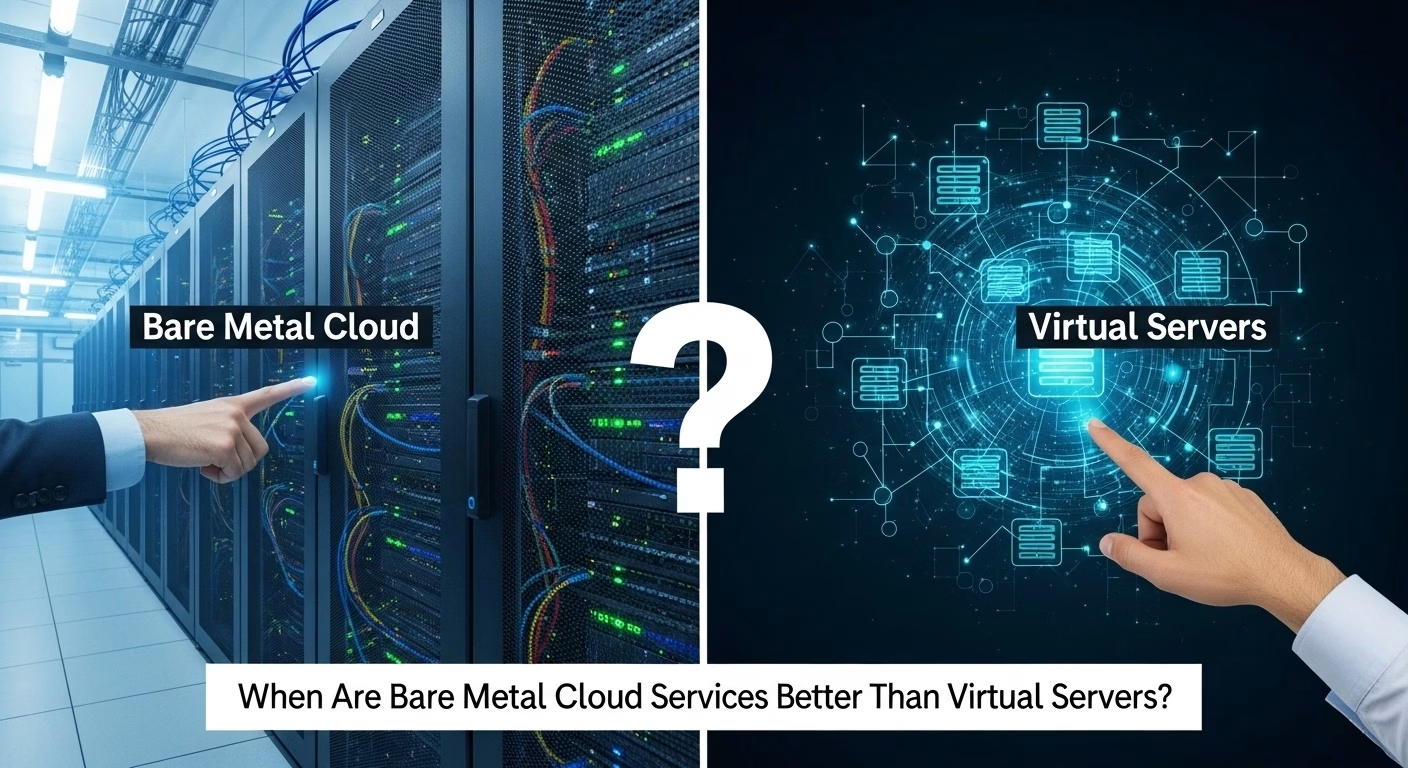
Virtual servers work well for most businesses. They are flexible, affordable, and easy to scale. For many projects, that combination is more than enough. But there comes a point in some organizations where “virtual” begins to feel limiting. Not because it fails. Not because it crashes. But because performance ceilings become visible.
High-demand applications, enterprise databases, financial systems, heavy analytics workloads these environments behave differently. They consume resources consistently and often unpredictably. And when that happens, sharing hardware at any layer starts to introduce subtle instability. That is usually when teams begin exploring bare metal cloud services in Pakistan.
What Bare Metal Actually Means in Practical Terms
A bare metal server removes the virtualization layer entirely. Instead of sharing physical hardware with other users even in isolated virtual partitions the entire machine is allocated to a single client. The CPU, RAM, storage, and network interface are not divided.
They are yours. For businesses evaluating dedicated infrastructure, the main benefit is not just performance. It is control without hidden contention. There are no neighboring virtual machines competing silently for physical resources.
No hypervisor overhead. No unpredictable spikes caused by unrelated workloads. The hardware behaves exactly as expected, because it belongs to one environment only.
Where Virtual Servers Begin to Show Limits
Virtual servers are excellent for flexibility. But under very high and consistent workloads, certain limitations appear:
- Resource contention at the hardware layer
- Slight latency introduced by virtualization
- Shared I/O channels
- Performance variability during peak activity
For most websites and applications, these differences are negligible. For example, content-driven sites or businesses using best WordPress hosting solutions typically operate efficiently in optimized virtual environments. But for systems processing thousands of transactions per minute or running continuous database queries, those small differences can become meaningful. Organizations usually reach this point after experiencing performance unpredictability not failure, just inconsistency. And inconsistency is dangerous for enterprise systems.
Predictable Performance Is the Real Advantage
The strongest benefit of bare metal cloud services in Pakistan is predictability. If an application requires a certain amount of processing power, that power is physically available at all times. No virtual layer is reallocating cycles behind the scenes.
For industries such as:
- Financial services
- Enterprise resource planning
- Large-scale e-commerce
- Gaming infrastructure
- Data analytics and AI workloads
Predictability becomes more important than flexibility. When response time affects revenue or customer trust, even small performance variations matter.
Security Through Physical Isolation
Virtual servers offer logical isolation. Bare metal adds physical isolation. For businesses handling highly sensitive data, the absence of shared hardware can strengthen compliance posture and reduce certain risk categories. With dedicated physical infrastructure, organizations control:
- Hardware-level security policies
- Network segmentation
- Custom firewall configurations
- Full operating system control
There is no concern about other tenants occupying the same physical machine. For enterprises, that physical boundary often simplifies audits and regulatory alignment.
The Cost Question Why Bare Metal Isn’t Always the First Choice
It would be unrealistic to ignore cost. A physically allocated server naturally costs more than a VPS. Hardware, data center power, cooling, and maintenance are no longer divided among multiple users. So the decision is rarely about price alone. It is about workload intensity and risk tolerance. If a virtual environment can handle the demand without strain, it remains the smarter financial choice. But if applications are consistently pushing performance ceilings, staying virtual can create hidden costs slowdowns, lost transactions, frustrated users. Sometimes paying more prevents larger losses.
When Bare Metal Makes Clear Sense
Businesses typically move toward dedicated hardware when one or more of these situations occur:
- High database transaction volumes
- Heavy analytics processing
- Real-time gaming or streaming workloads
- Enterprise platforms supporting hundreds of concurrent users
- Strict compliance requirements
- Performance-sensitive applications with zero tolerance for variability
In these cases, virtual infrastructure may still function but not optimally. Bare metal removes the guesswork.
Cloud + Bare Metal: A Hybrid Approach
Modern infrastructure no longer forces a choice between flexibility and hardware ownership. Many providers now combine cloud management tools with physical server allocation. That means businesses gain:
- Dedicated physical hardware
- Rapid provisioning
- API-based control
- Scalable networking
This hybrid structure keeps the operational convenience of cloud systems while delivering raw hardware strength. For companies exploring bare metal cloud services in Pakistan, this combination offers both control and usability.
Long-Term Growth Considerations
Choosing bare metal is often a forward-looking decision. If infrastructure demands are steadily increasing, investing in physical servers early can prevent frequent migrations. Instead of upgrading repeatedly from shared to VPS to VDS and then to dedicated, some organizations move directly to bare metal once workload projections justify it.
The right timing depends entirely on growth patterns. Technology should expand alongside business not chase it.
How Chromeis Approaches Bare Metal Infrastructure
At Chromeis, bare metal solutions are positioned carefully. They are not marketed as “better” than virtual servers only more suitable in certain conditions.
The focus remains practical:
- Dedicated hardware for high-performance demands
- Secure, isolated environments
- Strong data center infrastructure
- Stable networking for enterprise workloads
When businesses truly need physical allocation, the infrastructure is designed to support long-term reliability not just raw power. Because at enterprise scale, reliability is more valuable than peak performance numbers.
Final Thought
Not every business needs bare metal. And not every workload justifies physical hardware. But when performance consistency, compliance control, and long-term scalability become strategic priorities, virtual environments can start to feel like a temporary solution. The right infrastructure decision is rarely about trends it’s about alignment. For growing organizations in Pakistan, understanding when to move from virtual servers to dedicated physical infrastructure can mean the difference between managing growth and struggling to keep up with it.
Similar Post
Power Resource-Intensive Workloads Using Bare Metal Cloud Services
Some workloads don’t tolerate sharing. They don’t scale politely.