

I’ve yet to see an IT project where hiring didn’t become a problem at some point. Not because people didn’t want to hire. But because hiring never shows up when you need it.
You notice the gap first. Someone leaves. Or the workload increases. Or a deadline suddenly feels closer than it did last week. At first, everyone adjusts. Someone takes on extra tasks. Someone stays late. No one says anything. That’s how it usually starts. Then weeks pass.
The role stays open longer than expected
You put the job out there. CVs come in. Some look fine. Some clearly aren’t. A few might work, but they’re not available immediately. Or they want more money than planned. Or they don’t quite fit what the project actually needs.
So you wait. While you wait, the project keeps going. Or tries to. Progress slows down. Quality slips a little. Nobody calls it a crisis, but it doesn’t feel right anymore. That waiting period is expensive. Not on paper. In reality.
This is where staff augmentation enters the picture
Not as a clever strategy. Not as a buzzword. As a reaction. Businesses use staff augmentation because they don’t want to stop everything just to hire one person. They want someone who can step in, understand the work, and start contributing without months of buildup.
This is why models like Staff Augmentation: The Way Businesses Are Growing are becoming more common they solve an immediate problem instead of creating a long-term gamble.
It doesn’t replace your team
This is important, because people get defensive about it. Staff augmentation doesn’t mean replacing internal staff. It doesn’t mean outsourcing responsibility. It doesn’t mean losing control.
The people come into your system. Your tools. Your meetings. Your decisions. The only difference is how fast they arrive and how long they stay.
Hiring tries to solve tomorrow’s problems today
Traditional hiring forces you to predict the future. You don’t just hire for what you need now. You hire for what you might need later. That’s risky.
Projects change. Priorities shift. Budgets tighten. Sometimes you hire someone great and then realize you don’t actually need that role anymore. Staff augmentation avoids that trap. You add people when the need is real. When the work is already there.

Time is usually the biggest loss
People talk about salary when they talk about cost. But time is the real loss. Time spent interviewing. Time spent onboarding. Time spent waiting for someone to become productive.
While all that is happening, the work still exists. Staff augmentation shortens that gap. Someone who already knows how to work in similar environments. They don’t need months to ramp up. That alone saves more money than people realize.
Dedicated teams without permanent weight
Some projects don’t need one person. They need a small group that stays focused. A dedicated development team through staff augmentation gives you that focus without the long-term burden.
The team works together. Knowledge stays in one place. Progress doesn’t reset every few weeks. This is often where Staff Augmentation: Real-World Way to Grow Your IT Team makes the biggest impact.
Specialized roles are easier to access this way
Some skills are hard to hire quickly. Salesforce specialists. Senior developers. Project managers who’ve actually handled complex delivery.
Hiring them permanently doesn’t always make sense, especially if the need is temporary or tied to one phase of a project. Staff augmentation makes these skills available without forcing long-term commitments — including roles like project management staff augmentation where experience matters more than onboarding time.
Internal teams feel the relief first
This is something people don’t talk about enough. When teams are understaffed, they don’t always complain. They just absorb the pressure. They work around gaps. They lower expectations quietly.
That’s how burnout starts. Adding augmented staff reduces that pressure. Work gets distributed properly again. People focus on what they’re good at. Quality improves without anyone needing to work harder.
Planning becomes less hopeful, more real
Hiring uncertainty makes planning emotional. Timelines become guesses. Deadlines feel flexible. Stakeholders stop trusting schedules.
With staff augmentation, capacity is clearer. People are available. Plans are based on reality instead of optimism. That predictability changes how projects feel day to day.
It’s not only about developers
IT staff augmentation isn’t limited to coding roles. Businesses use it for:
- developer staff augmentation
- project management staff augmentation
- QA and testing
- Salesforce staff augmentation
- infrastructure and support
The model stays the same. The role changes. That consistency makes it easier to scale teams up or down without chaos.
Why this fits businesses in Pakistan
In Pakistan, things change quickly. Budgets shift. Clients change requirements. Projects pause and restart. Long-term hiring can feel risky.
Staff augmentation fits because it doesn’t lock businesses into decisions that might not make sense later. You stay flexible without slowing down.
Control stays where it belongs
This part matters. With staff augmentation, control doesn’t leave the business. You decide priorities. You set direction. You approve work.
Augmented staff support execution. They don’t redefine strategy. That separation keeps accountability clear.
Where ChromeiS fits
ChromeiS approaches IT staff augmentation in a very straightforward way. The focus is not fancy:
- bring in people quickly
- match skills to actual needs
- integrate smoothly with existing teams
- stay flexible as projects evolve
Whether it’s one role or a dedicated development team, the goal is to keep things moving without unnecessary friction.
Growth rarely follows a clean plan
Most businesses don’t grow in straight lines. Some months need more people. Some don’t. Some projects expand unexpectedly. Some end early.
Staff augmentation allows businesses to adapt without rebuilding their structure every time something changes. That adaptability saves energy as much as it saves money.
Final thought
Hiring will always matter. But waiting doesn’t have to. IT staff augmentation reduces hiring time and costs by matching skills to the moment instead of locking businesses into assumptions.
It’s not clever. It’s practical.
Similar Post

When IT Staff Augmentation Services Are Better Than Full-Time Hiring
Most businesses don’t plan to hire external technical support.
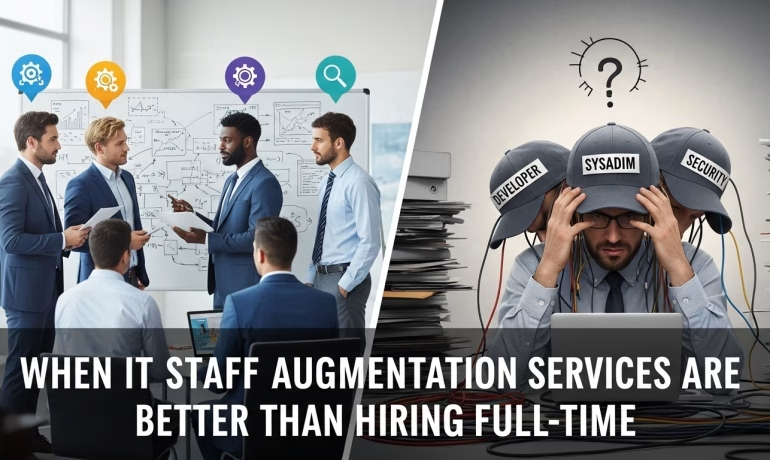
When IT Staff Augmentation Services Are Better Than Hiring Full-Time
Most businesses don’t decide to use IT staff augmentation