

Let’s be honest—most apps don’t explode on launch day. They slowly fall apart afterward.
The release goes live. Nothing crashes immediately. A few users sign up. Everyone relaxes. Then, a week or two later, support tickets start piling up. Pages take longer to load. Certain actions work sometimes and fail other times. Updates fix one issue and quietly create three new ones.
At that point, teams usually say the same thing: “But it worked during testing.”
And that’s exactly the problem.
Why internal testing gives a false sense of safety
Most testing happens in safe environments. Clean data. Stable connections. Predictable flows. People who already know how the product is supposed to work.
Real users don’t behave like that.
They tap buttons twice. They leave forms half-filled. They open apps on old phones. They use poor internet connections. They do things no test case ever imagined.
So when an app survives internal testing but breaks in production, it’s not surprising. It was never tested against real behavior in the first place.
How quality assurance gets pushed into the background
In many companies, QA exists—but only technically.
Testing usually starts after development is “finished.” Deadlines are already tight, so issues found late feel like obstacles instead of warnings. Bugs become negotiations. Performance problems get postponed. Security checks are labeled “phase two.”
QA turns into a reporting role instead of a preventive one.
And when that happens, releases stop being reliable. They become hopeful.
Why apps fail after launch, not before
Most post-launch failures are quiet.
- A checkout flow slows down just enough to increase drop-offs
- A mobile update breaks compatibility on older devices
- Database queries get heavier as usage grows
- Integrations behave differently outside staging
None of these look dramatic during demos. But users feel them immediately. And users don’t wait around for fixes. They leave.

The real misunderstanding about QA
A lot of teams think quality assurance is about finding bugs. It’s not.
Good QA is about reducing uncertainty.
It answers questions like:
- What happens when traffic spikes?
- What breaks when data grows?
- What fails when users behave differently than expected?
- What risks are we accepting with this release?
When those questions aren’t asked early, production becomes the testing ground. And users become testers—without consent.
Why Testing as a Service works differently
Testing as a Service works because it removes the idea that testing is a phase you “enter.”
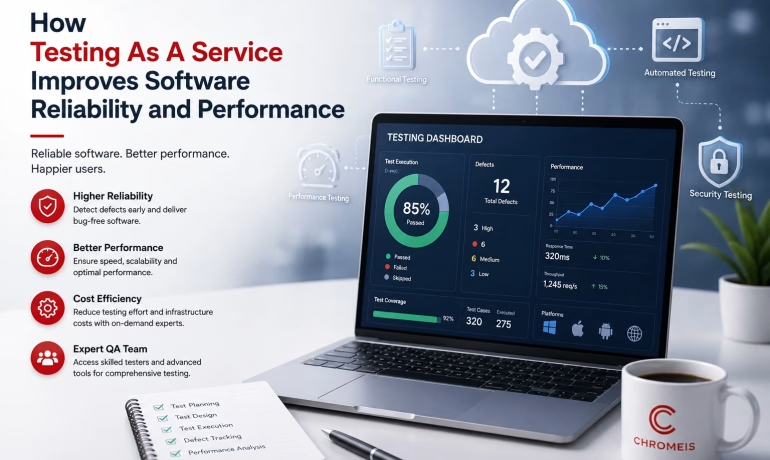
Instead, testing runs continuously. Automated checks catch regressions quietly. Performance issues are detected before users complain. Releases are evaluated based on real usage patterns, not assumptions.
TAAS also solves a practical problem most teams won’t admit: they don’t need a large QA team all the time—but they desperately need one at the worst possible moments. TAAS gives flexibility without chaos.
The hidden cost of skipping proper testing
When apps break after launch, the cost spreads fast.
Users lose trust first. Support teams feel pressure next. Engineers stop building and start fixing. Marketing slows down because growth exposes weaknesses instead of strengths.
What’s frustrating is that most of these issues were avoidable. Not through perfection—but through better testing decisions.
What “good enough” QA actually looks like
Effective QA doesn’t mean endless testing. It means focused testing.
That includes:
- validating real user journeys
- automating critical paths
- testing performance before scale
- treating security as part of quality
- prioritizing issues by business impact, not ego
When QA works this way, launches stop feeling risky. Teams stop holding their breath after deployments.
Where Chromeis fits—without making noise
Testing only works when it reflects real infrastructure and real usage.
This is where Chromeis Testing as a Service fits naturally. By combining automation, performance validation, and structured QA workflows, Chromeis helps teams catch problems before users notice them—without slowing releases or adding unnecessary process.
It’s not about more tools. It’s about fewer surprises.
Final thought
Most apps don’t fail because developers did bad work. They fail because quality was treated as something to check off instead of something to design into the product.
In today’s market, users don’t forgive instability. They move on. And once they do, it’s hard to get them back.
Similar Post

How Testing As A Service Supports Continuous Software Quality
Software quality is no longer something businesses can evaluate
How Testing As A Service Improves Software Reliability and Performance
Software problems rarely appear at a convenient time. They